
Join us on 2 July for the Polish-Hungarian feast at the Serketanc csángó tabor in Tokaj region
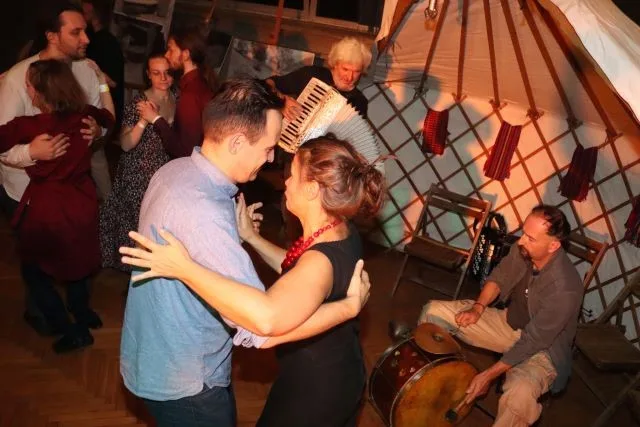
On 2 July, Wednesday, as part of Serketánc tabor, the best camp presenting Czango culture, we invite you to taste Polish traditional culture – there will be dance workshops and a concert, where the Bratanika Band and friends will take participants on a journey through Polish melodies and invite them to dance, sing and make music together. There will also be plenty of learning and playing to the tunes of Czango. You are cordially invited!
About the Serketánc Tabor
The ‘Serketánc’ community has been active since 2009, primarily promoting the culture of the Csángó Hungarians of Gimesz (Hungarian: Gyimes) and Moldva. Since then, they have been organising week-long summer music camps every year, which complement the instrumental weekends held throughout the year. The week-long summer camp attracts 250-300 people each year, of whom around 100 people – including many young people and children – learn to play an instrument (oboe, flute, violin, drums, clarinet, brass instruments). Learning to play instruments at the camp is complemented by dance and singing lessons, art classes, puppet theatre, professional programmes, concerts and, of course, dances until dawn with the opportunity to practise the skills acquired during the day. They pay special attention to the children’s musicians so that they can prove themselves. ‘Each time we invite a significant number of guests, mainly from the Csángó regions of Gyimes and Moldova. This has two purposes: on the one hand, we want to learn from them – primarily music, but also folk crafts, dance, gastronomy and values, and on the other hand, we want to convey to them that their knowledge is important and valuable, and that they are still in high demand,’ the organisers explain on their website ambrozsoky.moldva.hu. The substantive leader is Róbert Kerényi (the artist performed at the 3rd Csángó Festival in Poland and was awarded the prestigious Hungarian Heritage Prize in 2024) and the host of the venue is Ildikó Nagy-Bozsoky. The programme of the rolling stock is very rich, and all details and beautiful accounts of previous editions can be found at the above-mentioned link.

For the first time at the tabor, a Polish programme performed by the Bratanik band and friends
To present traditional Polish dances and dance games, chants and melodies, Joanna Mieszkowicz has invited exceptionally talented artists with a passion for Polish and Hungarian traditional culture, who will perform together under the name of the Bratanika band and friends.
Bratanika was created when three soul mates with a passion for both Czango and Polish culture met – Farkas Gyulai, Magdalena Olkiewicz and Piotr Kluczek. They met at the Czango Festival in Poland. The Polish-Hungarian brotherhood is united by playing the music of both nations together – Farkas leads in the Czango tradition, while Magda and Piotr introduce you to Polish music. We each play in multiple ensembles and are open to friends with whom we enjoy playing and dancing.
Piotr Kluczek – violinist with a basic musical education, playing traditional music of various regions of Poland and its closest neighbours for 5 years. He plays mainly violin, but also viola, hoop drum and bass in formations such as Kapela od 100dni gra muzyka Kapela Begebenheit, Vatra band.
Magdalena Olkiewicz – an enthusiast of all stringed instruments, with interests in the folk culture of Poland, Hungary and Greece. Her most frequently used instruments from this group include Greek bouzouki, Hungarian koboz, violin and vocal cords.
Farkas Gyulai is a versatile artist who regularly plays the music of the Moldavian Czangoša on a weekly basis at dance houses in Budapest (Gellérthegyi Víztározó, Háló klub) as part of the Szépszerével band – in duo with Gergő Sámsondi. He has visited Moldovan Czango villages several times, is a regular visitor to the Visnyeszéplak eco-village in the Somogy district, and since 2019 has visited many cities in Poland (Krakow, Torun, Gdansk, Jaroslaw, Warsaw) to participate in international traditional culture events, including the Czango Festival in Poland. His motto is to play music as if he were dancing to it. He can play, sing and dance at the same time. Invited friends include Katarzyna Barankiewicz, Przemysław Ostrowski and the aforementioned Joanna Mieszkowicz.
Kasia Barankiewicz is a violinist, multi-instrumentalist and dancer, founder of the Barankiewicz Band. She started her adventure with traditional music in 2022 during the Lublin Tabor and since then she has completely devoted herself to this passion. She plays the violin, bass and hoop drum. Przemysław Ostrowski is a musician, director, singer and dancer who has been practising folk dance for 15 years. He honed his skills with the dance masters from Przystałowice Małe, Mr. and Mrs. Cieślak. On the hurdy-gurdy he plays Polish grandfather songs and Ukrainian songs. He has been rooted in traditional music since childhood. He learnt to play the accordion from a folk harmonist Adam Kocerba, and plays in the Ostrowskis’ Non-Family Band, which he founded and which became the winner of the Old Tradition 2025, Mikołajki Folkowe in Lublin 2024 and the first place in the competition “From kujawiak to oberek” in Warta.
Joanna Mieszkowicz – dance lover and teacher of traditional dances, in particular the csángó and Polish dances, animator and promoter of both cultures. She has been in love with the Hungarian idea of dance houses since her first experience in Krakow in 1998. Polish taboras in the Lublin, Suwalszczyzna and Swietokrzyskie regions, csángó taboras in Somoska, Romania (2008), Serketánc taboras in 2012 (on the recommendation of Gergő Sámsondi), in 2008 she organised her first csángó dance house in Krakow with the participation of Hungarian artists, since 2019 she has been developing her activities popularising csángó circle dances, e.g. in the framework of the Csángó Festival in Poland and czangoteki (csángó parties). Co-founder of the Aeris Futuro Foundation.


Are you sure it’s for me?
If you are open to the unforgettable experience of communing with beautiful people, music, dances, landscapes, heat and delicacies of local and csángó production then this is definitely an opportunity worth taking.
We thank our patrons
Project co-financed under the Agreement between the Ministries of Foreign Affairs of Poland and Hungary on the financing of cooperation between NGOs.
The project is run by the Aeris Futuro Foundation, established in Krakow almost 20 years ago, which works for sustainable development, i.e. for the benefit of present and future generations, where taking care of natural and cultural heritage is very important. ‘We are pleased that our activities contribute to stimulating civic activity, creativity and international cooperation in the name of common values such as dialogue, peace and beauty,’ emphasise the organisers.
Detailed information
Joanna Mieszkowicz, project coordinator, Aeris Futuro Foundation, email: joanna.mieszkowicz@gmail.com, tel.+48 693 589 391.
And on the czango.pl and www.facebook.com/festiwalcsango