
Mária Petrás
Mária Petrás is a folk singer, ceramicist, winner of the prestigious Prima Primissima Award and the Hungarian Heritage Award, and a member of the Hungarian Academy of Arts (MMA). One could venture to say that she is the Hungarian equivalent of Cesaria Evora or Maria Siwiec.
While learning her mother tongue as a child, Mária Petrás simultaneously absorbed ancient Moldavian Hungarian songs, ballads and Gregorian chants with an authentic way of presentation. Her way of singing is in keeping with the richly colourful style of the region’s best country singers, which has been admired by many folklorists and musicians such as Béla Bartók.
She was born in 1957 in the village of Diószén in Moldova, a region within the borders of Romania. This is an area inhabited by the Changs (Csángó), an ethnic minority of Hungarian origin. The Csángó arrived in the area of historical Moldova at the turn of the 13th and 14th centuries and speak a dialect of the Hungarian language. For many years, the Changs were not allowed to cultivate their own culture. Unlike the Orthodox majority of Romanians, they are Catholics and, since the time of their settlement in Moldova, it is the faith that has played an important and cohesive role.
Mária Petrás shapes and fires her deep awareness of the roots of the Csángó people, their communal values, human mastery and the relationship between God and humanity in clay. As a child, she learned about Moldavian Csángó decorative art. In 1990, she moved to Hungary, where she attended the Budapest School of Applied Arts, specialising in ceramics. The richness of her work is evident in how she combines elements from different periods of art history. In a given work, the viewer can find elements of ancient sculpture, medieval church art, as well as characteristic elements of folk art. The discerning viewer will notice elements of traditional Moldovan costume in her figurines: a traditional kerchief, strands of beads, ribbons from an infant’s clothes. Her magnificent ceramic works, expressing her soul, can be found all over the world. Mária Petrás has so far had more than 300 exhibitions in Europe and around the world.
In addition to her exhibitions and performances, Maria has always been, and continues to be, involved in community work running workshops for children and adults. Her studio in Pomaz is always open to anyone who would like to spend some time with her and receive power or healing from her pure spiritual source.
Maria expresses her respect for different cultures, especially Christian nations such as Poland. Her most remote exhibition took place under the Southern Stars in Australia, in 2015. During this series of exhibitions, one of the events was organised by the Polish Consulate in Sydney.
Maria always feels honoured to visit Poland and share her rich heritage in art and humanity with others.
For more information about the Artist:
https://hu.wikipedia.org/wiki/Petr%C3%A1s_M%C3%A1ria
https://www.mma-tv.hu/mma-tv/-/person/1297579/
Singing by Maria Petras:
Ceramics and singing by Maria Petras:
https://www.youtube.com/channel/UC_ECU09FYzT-R-9uOzn_0Eg
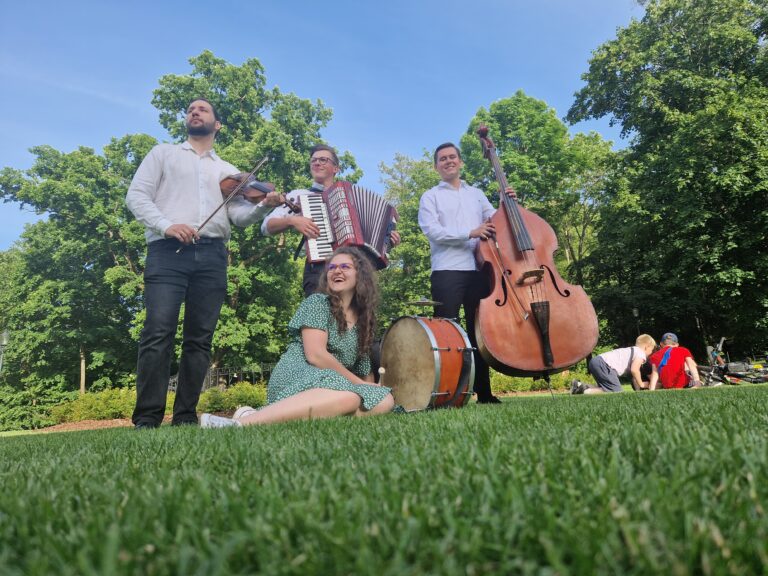
IV Csángó Festival in Poland
Concert “The riches of chango culture”